YAMAHA 6H5-85560-01-00 Outboard Stator Magneto Base 40 50
fits make: Yamaha. year: 1989–1992.
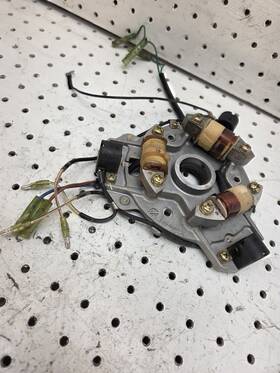
( Manufacturer Part Number: 6H5-85560-01-00 ), ( Part Type: Stator Magneto ), ( Materials Sourced From: Japan )
Review YAMAHA Outboard 40 50 Stroke Stator Magneto Base fits 1989–1992
The **Yamaha 6H5-85560-01-00 Stator Magneto Base** is a critical and highly specialized component designed for Yamaha outboard motors produced between **1989 and 1992**, specifically for the **40 and 50 horsepower series**. This stator magneto base serves as the foundational housing for the ignition system, housing the stator windings, rotor, and associated electrical components that generate the high-voltage spark necessary for engine ignition. Crafted with precision engineering, this part is integral to the reliable performance of the motor, ensuring consistent power delivery and smooth operation under varying load conditions. The stator magneto base is typically constructed from durable, corrosion-resistant materials, including high-grade aluminum or reinforced plastic, to withstand the harsh marine environment while maintaining structural integrity over extended use. Its design incorporates precise tolerances to accommodate the stator windings and rotor assembly, which work in tandem to convert mechanical motion from the engine s flywheel into electrical energy. This component is essential for the proper functioning of the ignition system, as it houses the coils that induce the voltage required to fire the spark plugs, thereby ensuring efficient combustion and optimal engine performance. For boaters and mechanics maintaining or restoring classic Yamaha outboards from this era, sourcing an authentic **6H5-85560-01-00** stator magneto base is vital for restoring or preserving the original functionality of the motor, as aftermarket or incompatible replacements may compromise reliability and efficiency. Whether used in restoration projects, performance upgrades, or routine maintenance, this part exemplifies Yamaha s commitment to durability and precision in marine propulsion systems.
### **Pros and Cons of Buying a Yamaha 6H5-85560-01-00 Outboard (1989 1992, Stator Magneto Base, 40 50 HP)**
#### **Pros**
1. **Reliability and Durability** Yamaha s 6H5 series (part of the 40 50 HP range) is known for its robust construction and long-lasting engine components. The stator magneto base (a pre-electronic ignition system) is simpler than modern fuel-injected engines, making it easier to repair and maintain with basic mechanical skills.
2. **Lower Cost of Ownership** Compared to newer outboards, parts for this model are relatively affordable, and labor costs for repairs are lower. The lack of complex electronics reduces the risk of costly failures from sensor malfunctions or computer issues.
3. **Simplicity in Maintenance** The magneto ignition system is straightforward to service, requiring only basic tools. Carburetors (if still in use) are easier to tune than modern fuel injection systems. Owners with mechanical experience can perform many repairs themselves.
4. **Good for Basic Boating Needs** This engine is well-suited for small boats, trolling, or recreational use where high performance isn t required. It provides steady power for cruising, fishing, or light duty without the need for aggressive acceleration.
5. **Availability of Used Parts** Since these engines were produced in the late '80s and early '90s, a wide range of used parts (stators, rotors, carburetors, gaskets, etc.) are still available through marine dealers, online marketplaces, or salvage yards.
6. **Lower Fuel Consumption** Older outboards tend to be more fuel-efficient than modern high-performance engines, especially when used for steady-speed cruising rather than high-speed running.
7. **Potential for Restoration** If the engine is in rough shape, restoring it can be a rewarding project. Many owners enjoy the process of rebuilding and fine-tuning an older Yamaha, which can extend its lifespan significantly.
8. **Lower Initial Purchase Price** Compared to newer Yamaha outboards (even used), this older model will cost significantly less, making it an attractive option for budget-conscious buyers.
---
#### **Cons**
1. **Age-Related Wear and Tear** Engines from this era may have accumulated significant mileage (often 1,000 hours) and could require major overhauls, including cylinder head work, piston replacement, or crankshaft repairs. Buyers should expect to invest in refurbishment.
2. **Carburetion Issues** The 6H5 series typically uses a single or dual-carburetor setup (depending on the year), which can suffer from clogging, leaks, or poor tuning over time. Carburetors require regular cleaning and adjustment, and modern fuel additives may not be as effective as they are for fuel-injected engines.
3. **Ignition System Limitations** The magneto ignition is reliable but lacks the precision of modern electronic ignition systems. Over time, the magneto may wear out or develop misfires, requiring replacement. While parts are available, they may not last as long as modern components.
4. **Emissions and Modern Regulations** Older outboards do not meet modern emissions standards, which could pose issues if used in areas with strict environmental regulations. Some marinas or lakes may restrict or ban their use.
5. **Limited Performance** Compared to newer Yamaha outboards, this engine lacks the power, efficiency, and smoothness of modern designs. It may struggle with heavy loads, rough water, or high-speed applications.
6. **Fuel Quality Concerns** Older engines are more sensitive to fuel quality. Ethanol-blended fuels (common today) can cause carburetor and fuel system issues, requiring additional maintenance or the use of fuel stabilizers.
7. **Resale Value** Unlike newer Yamaha outboards, which retain some value, this model will depreciate further over time. If you plan to sell it later, the return on investment will be minimal.
8. **Potential for Hidden Problems** Without a thorough inspection, buyers may inherit issues such as:- **Cylinder wear** (leading to compression loss and poor performance).
- **Rod or bearing failure** (common in high-hour engines).
- **Coolant leaks** (water pump or head gasket issues).
- **Transmission wear** (if the gearcase is old, it may need replacement).
9. **Limited Warranty Coverage** Most used outboards from this era come with no warranty, leaving buyers responsible for all repair costs.
10. **Training and Skill Dependency** Operating and maintaining this engine requires a basic understanding of carburetors, ignition systems, and older marine mechanics. Novice boaters may find it more challenging than modern fuel-injected engines.
---
### **Conclusion**
The Yamaha 6H5-85560-01-00 outboard (1989 1992) is a solid choice for buyers who prioritize **affordability, simplicity, and reliability** over modern performance. It is best suited for:
- **Budget-conscious boaters** who can afford to invest in repairs or restoration.
- **Mechanically inclined owners** who enjoy working on their own boats.
- **Light-duty users** (trolling, small boats, occasional use) where high performance isn t necessary.
- **Project enthusiasts** who see value in restoring and maintaining an older engine.
However, it is **not ideal** for:- **High-performance or heavy-duty applications** (e.g., wakeboarding, towing, rough water).
- **Boaters who want low maintenance** (carburetors and ignition systems require regular attention).
- **Those who plan to keep the boat long-term** (resale value will be low).
- **Users in areas with strict emissions regulations** (may face restrictions).
---
### **Recommendation**
If you are considering this outboard, follow these steps to make an informed decision:1. **Inspect Thoroughly** Have a marine mechanic perform a **compression test, leak-down test, and visual inspection** of the engine, gearcase, and cooling system. Look for:
- Signs of **cylinder wear** (blue smoke, rough idle, loss of power).
- **Rod or bearing knock** (unusual noises under load).
- **Coolant leaks** (water in oil, overheating).
- **Carburetor condition** (cleanliness, proper float level, no clogs).
2. **Check the Hour Meter** Engines with **under 500 hours** are generally more reliable and require less work. Those with **1,000 hours** may need a major overhaul.
3. **Test Run** If possible, take the boat out for a **short test run** to listen for unusual noises (knocking, grinding) and check for smooth operation.
4. **Budget for Repairs** Be prepared to spend **$1,000 $3,000 ** on refurbishment, depending on the engine s condition. Common repairs include:
- **Carburetor rebuild or replacement** ($200 $600).
- **Magneto replacement** ($100 $300).
- **Gasket replacement** ($150 $400).
- **Cylinder head or piston work** ($500 $1,500 ).
5. **Consider Alternatives**
- If you want **modern reliability**, look for a **used Yamaha 40 50 HP fuel-injected outboard** (e.g., 2000s 2010s models) with **under 500 hours**.
- If you prefer **simplicity and low cost**, a **Mercury or Johnson outboard** from the same era may also be worth considering.
6. **Buy from a Trusted Source** Purchase from a **reputable dealer, auction with a return window, or a seller who offers a warranty**. Avoid "as-is" purchases without inspection.
7. **Maintain Proactively** If you decide to buy, **regularly service the carburetors, ignition, and cooling system** to extend its lifespan. Consider upgrading to a **modern fuel-injected outboard** if you plan to keep the boat long-term.
---
**Final Verdict:**The Yamaha 6H5-85560-01-00 is a **great budget-friendly outboard for experienced boaters** who can handle its quirks. For **casual or first-time buyers**, a newer or more modern outboard may be a safer long-term investment. If you re willing to put in the work, it can provide **years of reliable service** for light to moderate use.
Details:
Condition: Used. Freshwater parts only. Warranty: 30-Day Return Buyer Pays Shipping. FREE SHIPPING lower 48.
Notes: Used outboard part in good working condition. Quality used FRESHWATER magneto off of a 1989 50hp Yamaha outboard motor, Outboard 40 50 2 Stroke 1989 1992 Stator Magneto Base 6H5-85560-01- Brand. Sold as-is no warranty.
part #: 6h5855600100 prices
- $70.00-$75.00
specifications ouboaen:
- for makes: Yamaha
- for years: 1989-1992
- mpn: 6h5-85560-01-00
- part type: Stator Magneto
- materials sourced from: Japan
offer ouboaen:
- availability: In Stock
- started: May 6, 2026
- options: Ship-to-home
- sold: 0
- quantity: 1
- best offers: True
returns ouboaen:
- policy: Returns Accepted
- paid by: Seller
- time: 30 Days
payments ouboaen:
- credit card: Discover
- cash
- wallet: Google-pay
- other
seller ouboaen:
- # reviews: 1674
- city: Wetmore, Michigan
- rating: 99.7%
general ouboaen:
- condition: Used
- Boat Parts > Outboard Engines Components > Other
shipping ouboaen:
- cost: $0.00
- class: Standard, Economy
- transit: 2-6 Days
- type: Fixed
- carrier: UPS, FedEx, USPS
- service: UPS Ground, FedEx Ground Economy, USPS Ground Advantage
Yamaha 6H5-85560-01-00 Is Similar To:
- 0000 Yamaha 20hp 2 Stroke Short (41.1% similar) I used it mostly on lake Isabel a fresh water. Short shaft...(February 20th, 2017)
- 0000001 Yamaha Oem Outboard Digital (34.2% similar) Display photos show actual product buyer will get...(April 20th, 2017)
- 000001 Yamaha Dual Outboard Engine (36.4% similar) Was told that one of the neutral switches replaced inside, wiring harness extension is included need to be connected back because taken apart when rigging removed from boat. Some small parts and screws might be missed. Sometimes I just was unable to test it or some parts screws might be missed. ...(September 16th, 2017)
- 0x66 Yamaha Hp Outboard Motor (40% similar) Replaced gear lube but likely needs seal kit or new lower end. Compression on all cylinders. It is a standard left rotation and has just over 1100 hrs. This is a 1999 yamaha 225 hp OX66 saltwater series 2 stoke with lower end had some water in gear lube...(February 3rd, 2019)
- 10319 Stiletto Stainless Prop Mercury Yamaha Outboard Propeller (28.8% similar) Condition: used but in good condition and guaranteed to function properly. Part: 10319 stiletto stainless prop x 19P v6 mercury yamaha outboard propeller fits various mariner motor parts. Please see included pictures...(August 24th, 2018)
- 10321 Stiletto Prop Mercury Mariner Yamaha Outboard Propeller (29.2% similar) May fit more engines. Condition: used but in good condition and guaranteed to function properly. Please see included pictures. Part: 10321 stiletto prop x 21P v6 mercury mariner yamaha outboard propeller fits various motor parts. This propeller will also fit yamaha outboard motors with the correct ...(January 7th, 2019)
- 152041 Oem Yamaha Outboard Premier Ii Cable New In Box (36.9% similar) They are yamaha premier cabled 15 foot length I have 2 available this offer is for 1 thanks good luck. I got these for a boat was working on and needed up not using them, think paid over 50 each...(July 1st, 2018)
- 16715m Mercury Mariner Yamaha Outboard Linkage Rod Connector Joint (35.2% similar) Item mercury joint, part number 16715M. New old stock from dealer close out...(December 27th, 2018)
- 173362 Yamaha Outboard Boat Motor (38.5% similar) Yamaha outboard motor concealed side mount - control box item is a take off and like new...(March 27th, 2017)
- 18-2374 Sierra Marine Yamaha Outboard Magnetic Drain Screw Replaces (35% similar) Sierra marine yamaha outboard magnetic drain screw replaces 00USES gasket not included m8 thread...(January 22nd, 2019)
- 18-3066 Sierra Marine Mercury Mariner Yamaha Impeller Outboard 030999315182 (29.1% similar) Sierra marine mercury mariner YAMAHAOUTBOARDIMPELLER18-3066 mfr: part order UPC: 82 condition: new : mercury yamaha impeller. Mercury mariner outboards:replaces: 47-11590MYAMAHA 6G1 00FITS: 6/8 hp...(October 28th, 2018)
